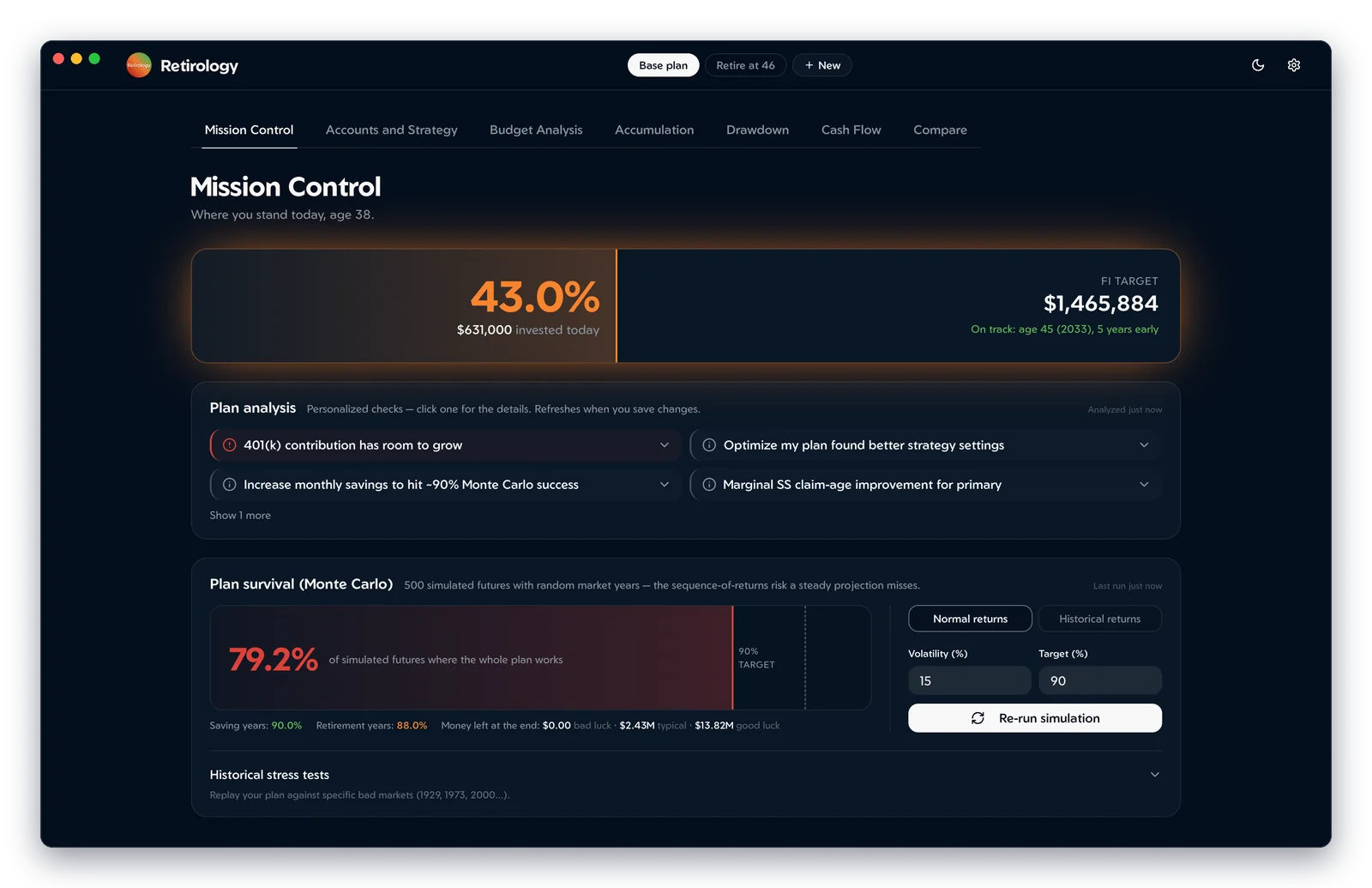
Mission Control
One screen with where you stand: progress to your FI target, the date your savings get there and whether that's ahead of schedule, your Monte Carlo odds against your goal, and personalized checks on what to fix first.
 Retirology
Buy once · Every future version free
Retirement planning software you buy once, built for retiring early: Roth conversion ladders, ACA subsidies, Monte Carlo, Social Security and 2026 tax rules for every state. It runs on your computer. No account. Your numbers stay yours.
macOS · Windows · Linux · Version 2026.0.5 — what's new
$19+ once, every update free · No subscription · No account · No data collection · Runs offline
New · Free open beta
Connect Retirology to Claude, ChatGPT, Gemini or another AI app that supports connectors. Your AI app sets up your plan with you a few questions at a time, then answers questions about it, with every number coming from Retirology's engine.
Anyone can join, free, for three months while we test it. If it proves useful, the full version launches in January 2027: what's planned. Unlike the desktop app, it runs its calculations on our server: what it sees and keeps.
Under your plan's settings, the room is about $58,000 to $85,000 a year for ages 50 to 59, then none from 60: the plan draws on the 401(k) instead, and from 62 the pension fills the room under the subsidy cliff.
| Age | Roth conversion | MAGI | % of poverty line |
|---|---|---|---|
| 50 | $65,626 | $106,600 | 400 |
| 52 | $18,016 | $84,600 | 400 |
| 54–59 | $84,600 | $84,600 | 400 |
Age 52 is lower because the plan's $40,000 car purchase is funded by selling brokerage shares, and those gains count toward MAGI.
From a beta test with a fictional household, in today's dollars. Educational projection, not advice.
What it does
Most retirement calculators give you a single number. Retirology models the whole arc — saving, then drawing down every account — with the taxes, healthcare and penalties that decide whether an early retirement works, and tells you what to change.
One screen with where you stand: progress to your FI target, the date your savings get there and whether that's ahead of schedule, your Monte Carlo odds against your goal, and personalized checks on what to fix first.
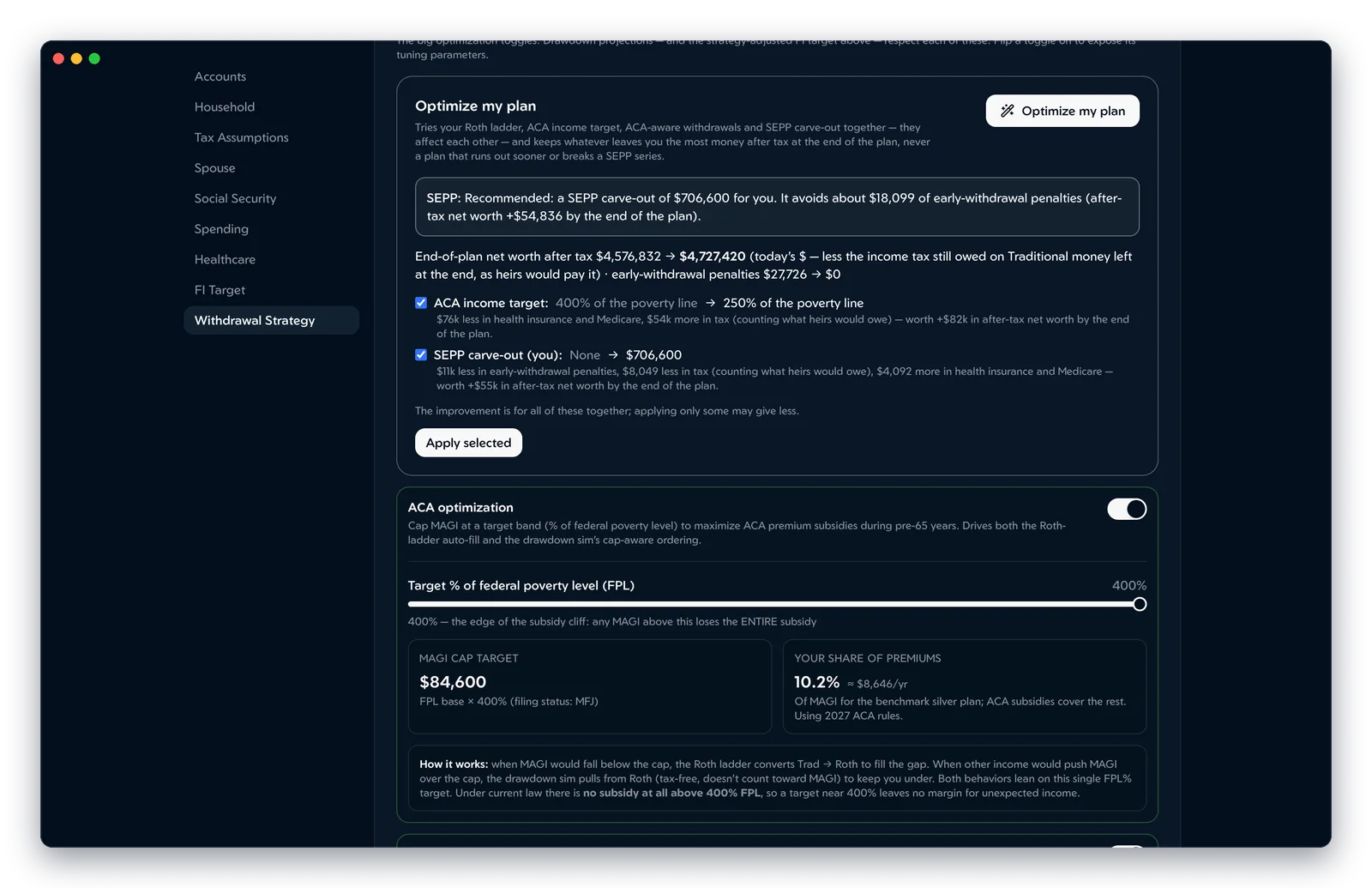
Your Roth ladder, ACA income target and SEPP choice affect each other, so tuning them one at a time rarely finds the best mix. One click tries them together, keeps whatever leaves you the most after tax, and explains every change in dollars.
All 50 states and DC under 2026 law, including the breaks most states give retirees: retirement-income exclusions by age, income-tested Social Security and capital-gains breaks — explained in plain English. See every state.
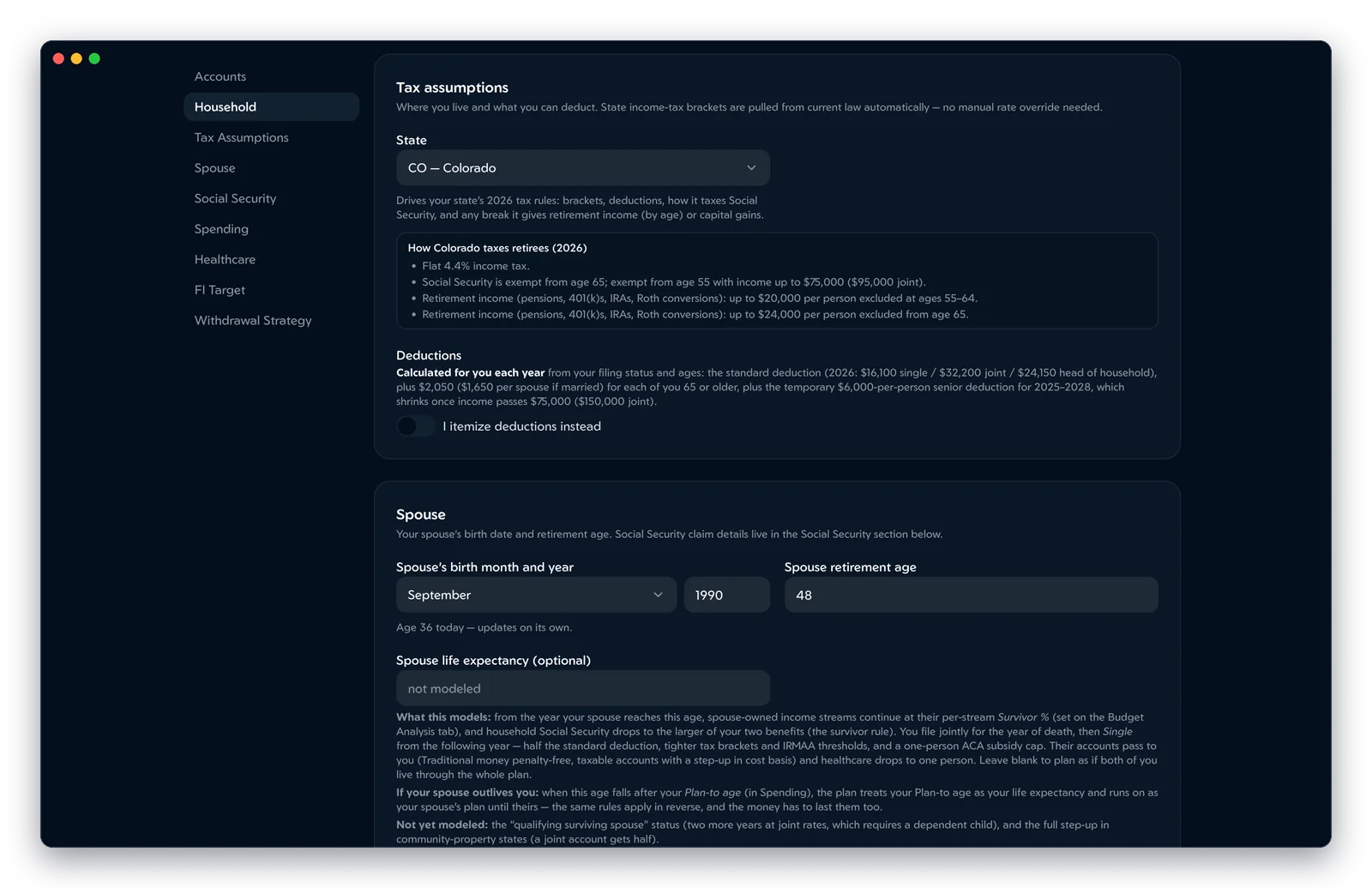
Four conversion modes — Auto-fill to your ACA cap, Spend-driven, Zero-tax and Manual — with each conversion's 5-year clock tracked. MAGI is held under the 2026 subsidy cliff, and 72(t) SEPP and the Rule of 55 cover the years before 59½. How ladders work.
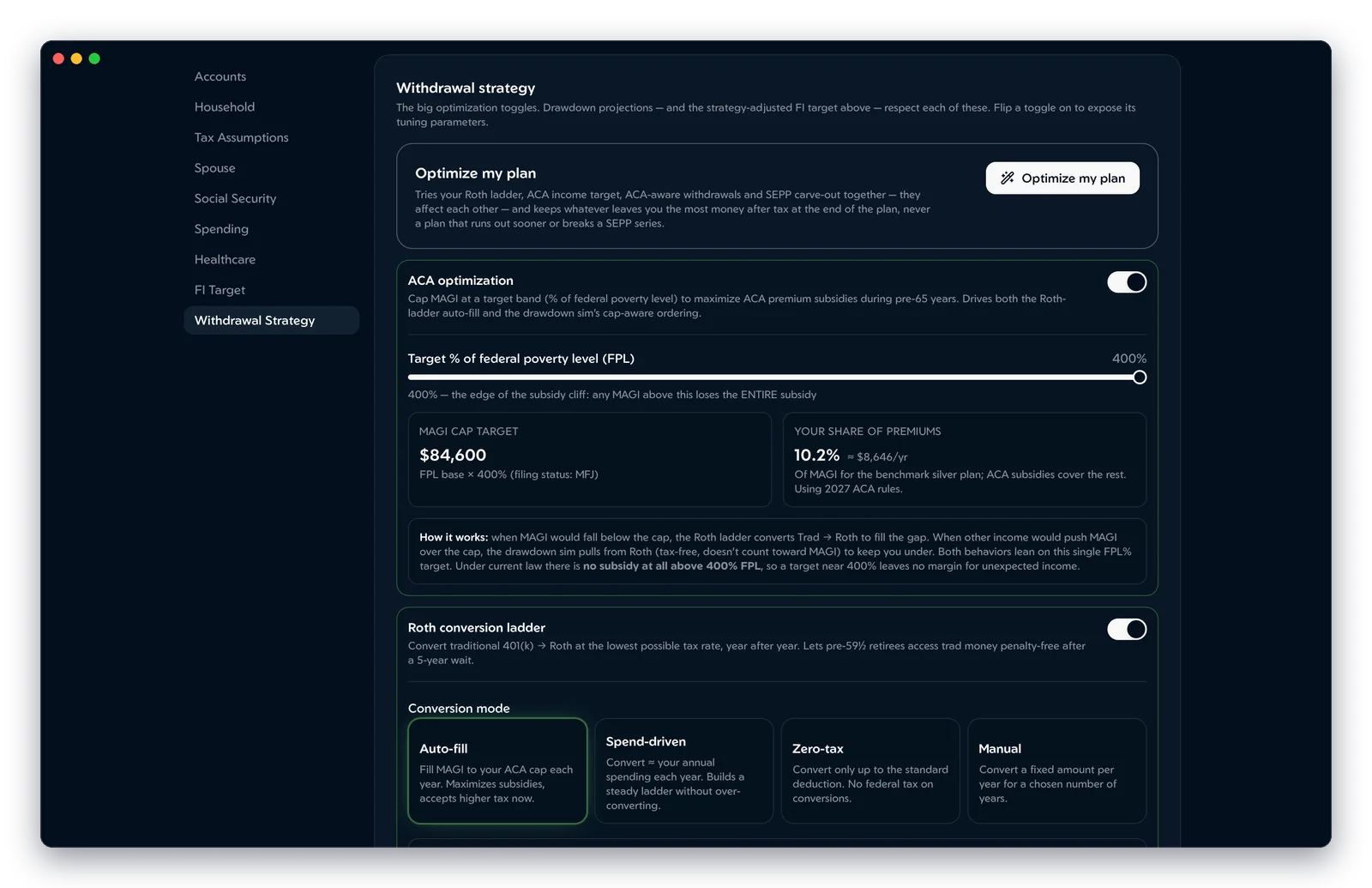
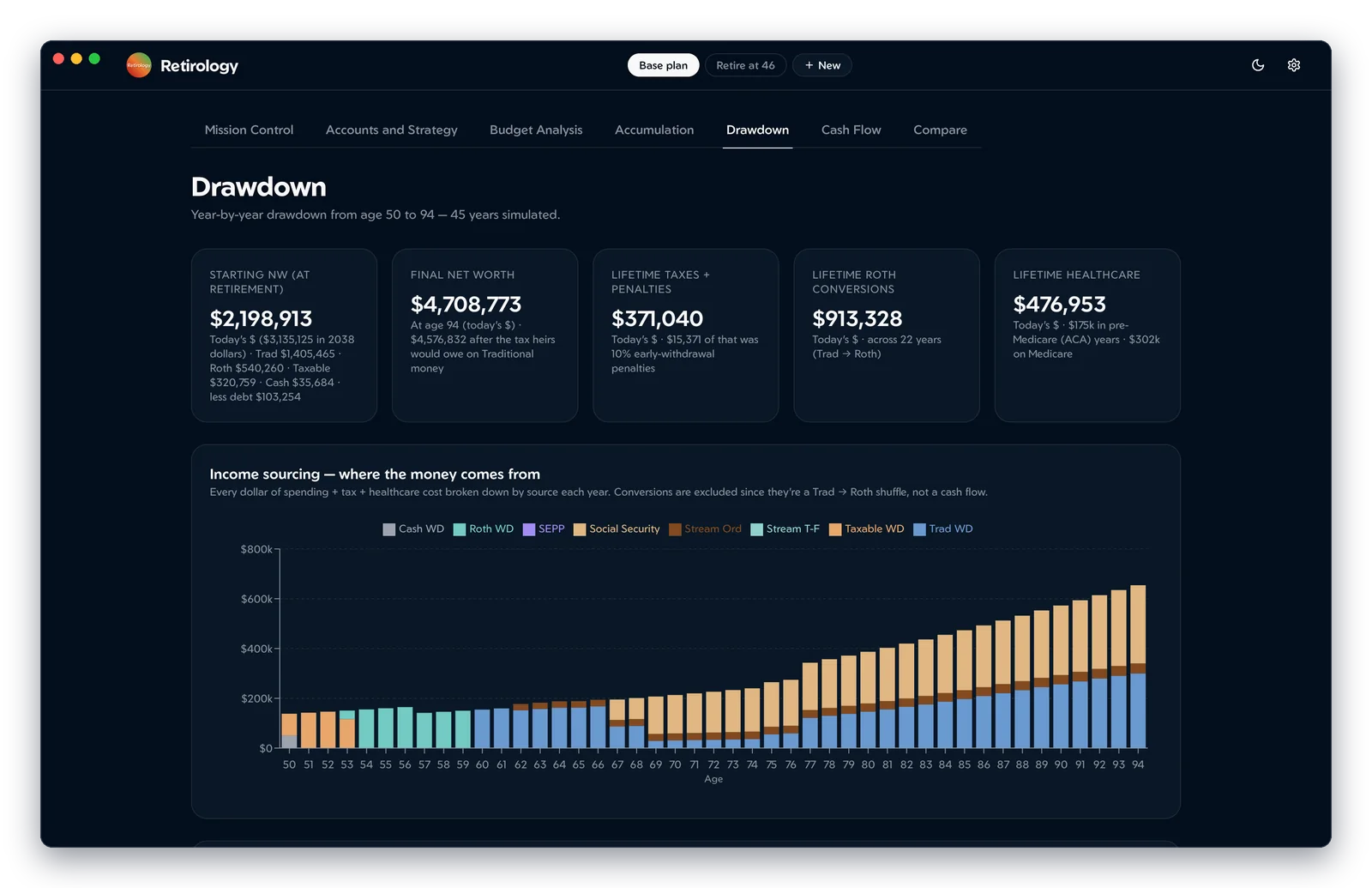
Every account tracked on its own, drawn in the order you choose, through federal and state tax, the 3.8% NIIT, early-withdrawal penalties, RMDs and Medicare IRMAA — across all four filing statuses, including survivor years. Totals are in today's dollars.
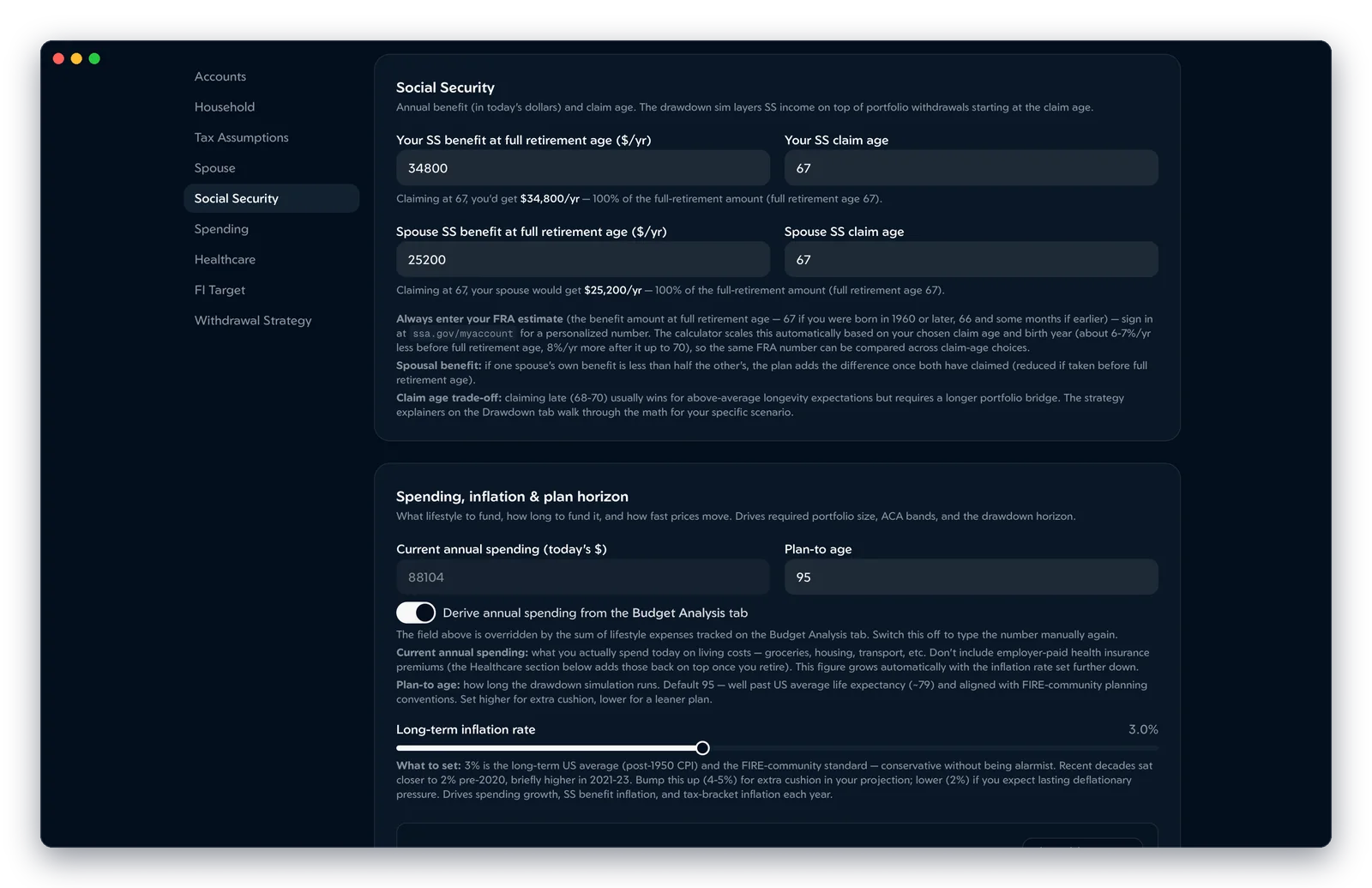
Your birth year's exact full retirement age, what each claim age pays, spousal benefits, and the survivor rule when one of you dies first — with inheritance and the right filing status afterwards.
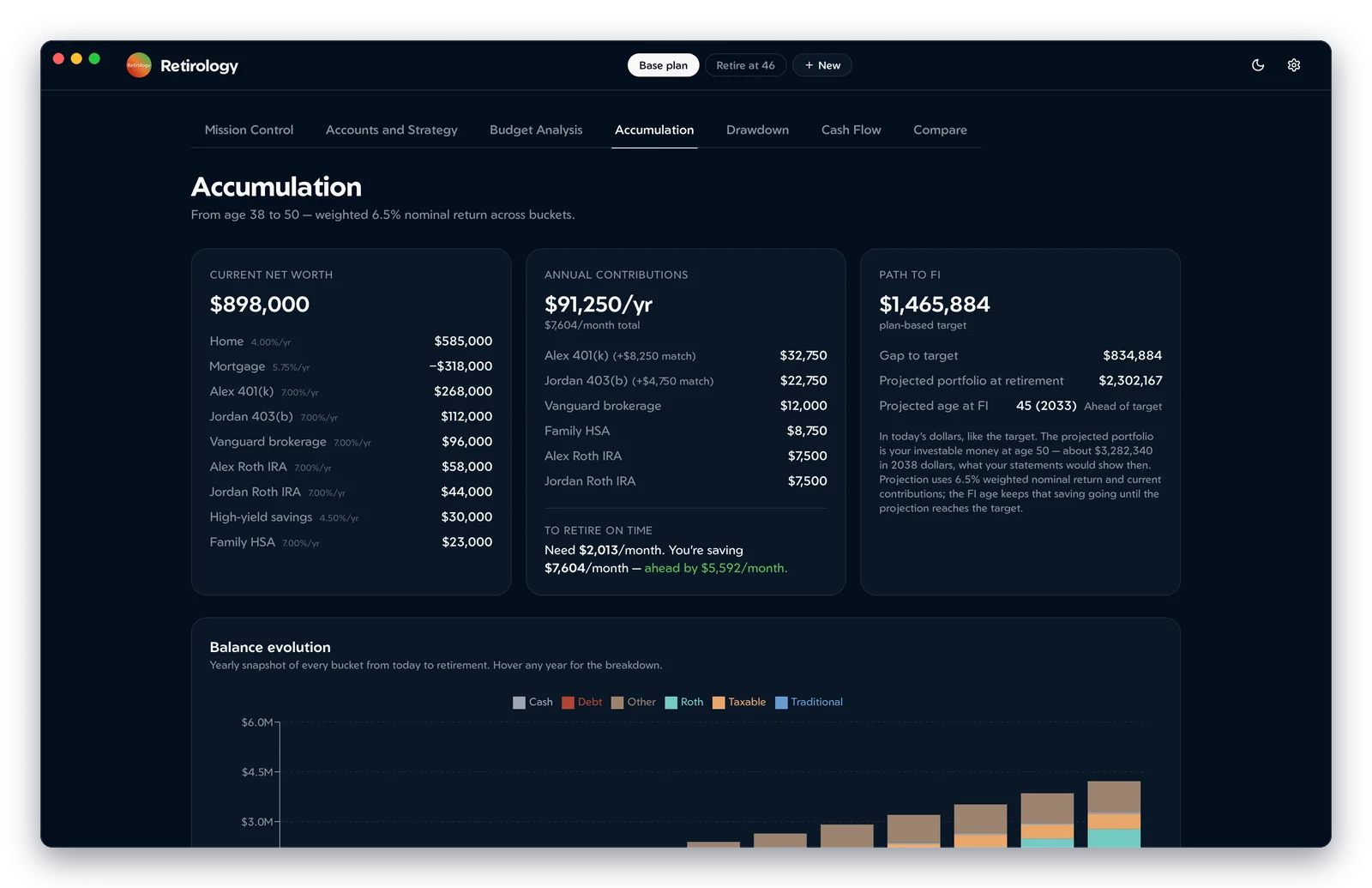
Per-account growth and contributions (with 2026 limits and catch-ups), employer match and HSA. Your FI target comes from a category-by-category budget and a simulation of your actual plan — not a guessed round number.
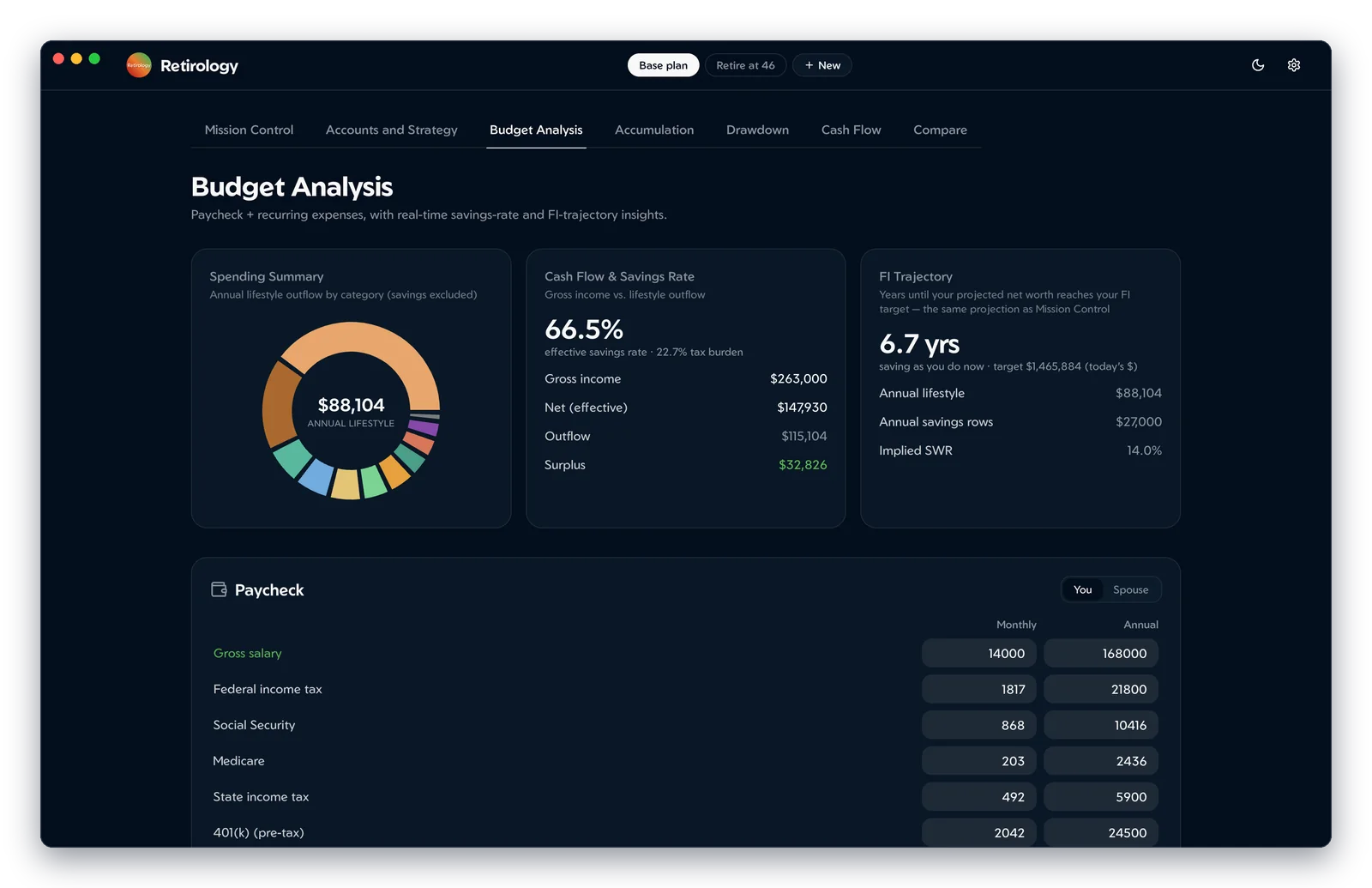
Paycheck and recurring expenses by category, your real savings rate, and how many years until you reach FI — plus a schedule for the changes ahead, like a paid-off mortgage or kids leaving home.
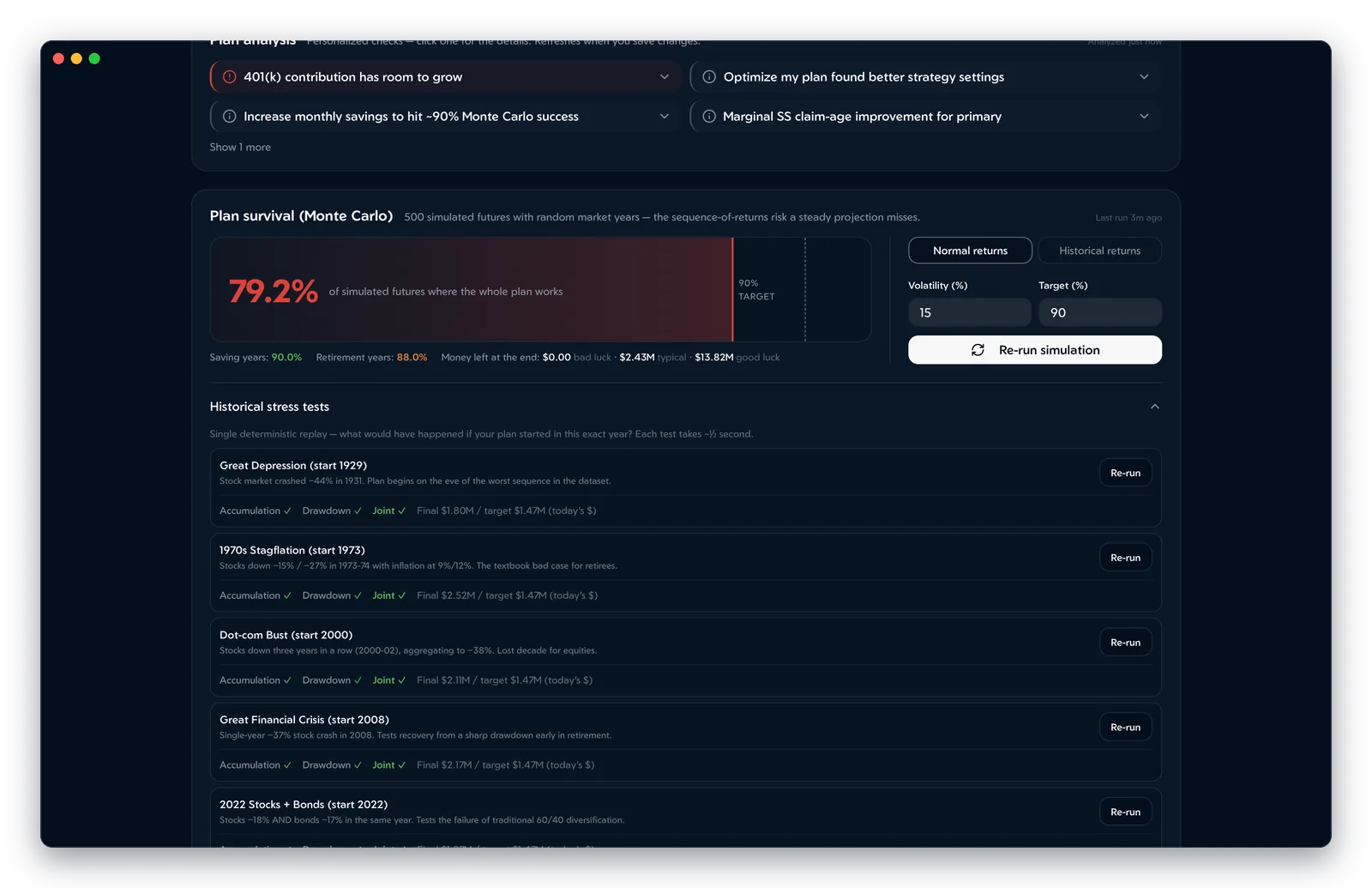
Run the whole plan — taxes and all — through hundreds of random or historical market sequences (1928–2024 data), see bad-luck, typical and good-luck outcomes, and replay retiring in 1929, 1973, 2000, 2008 and 2022.
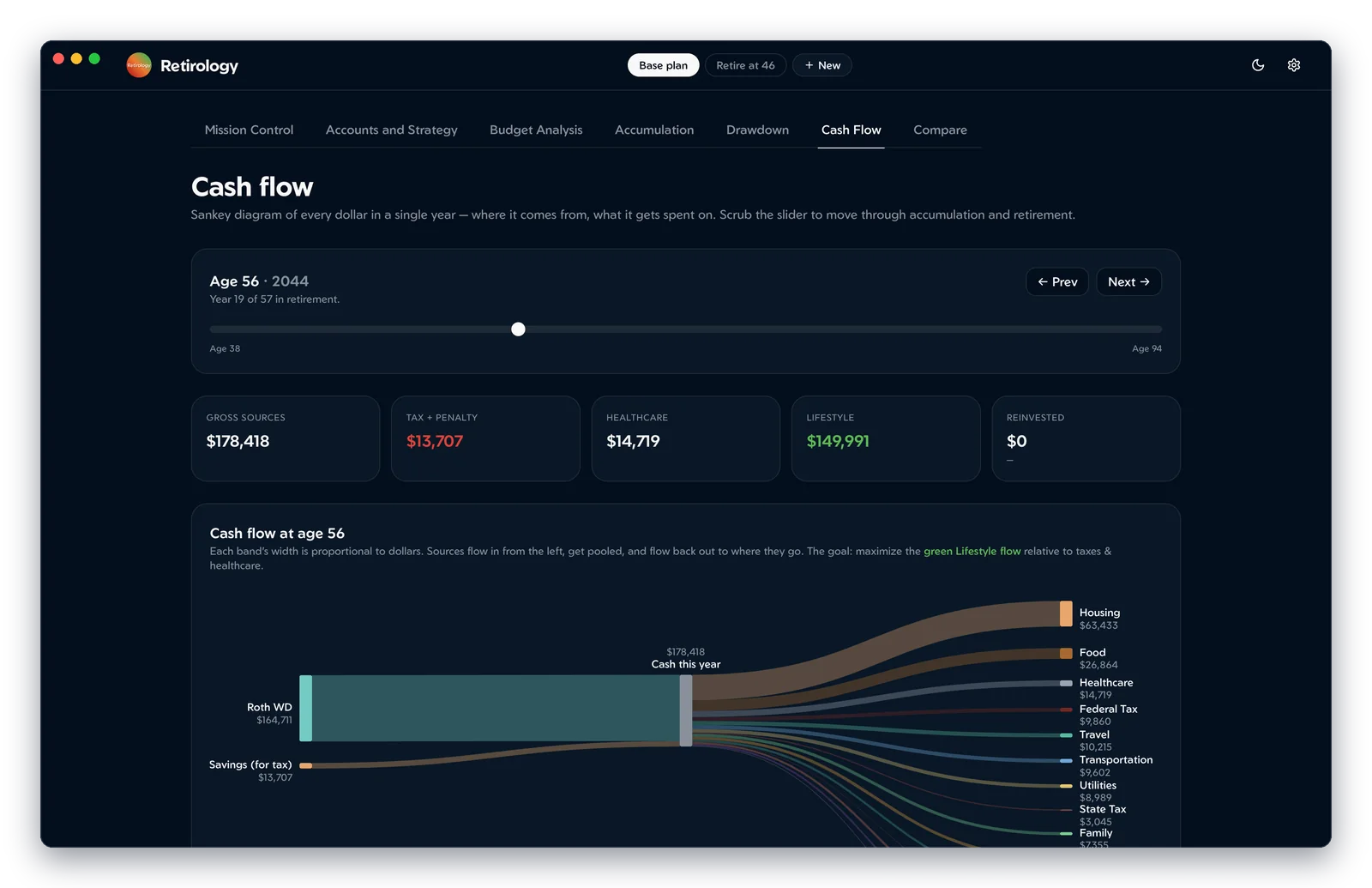
Trace every dollar of any year — from accounts and Social Security, through taxes and healthcare, to what you actually spend. Scrub through the years from your first working year to your last.
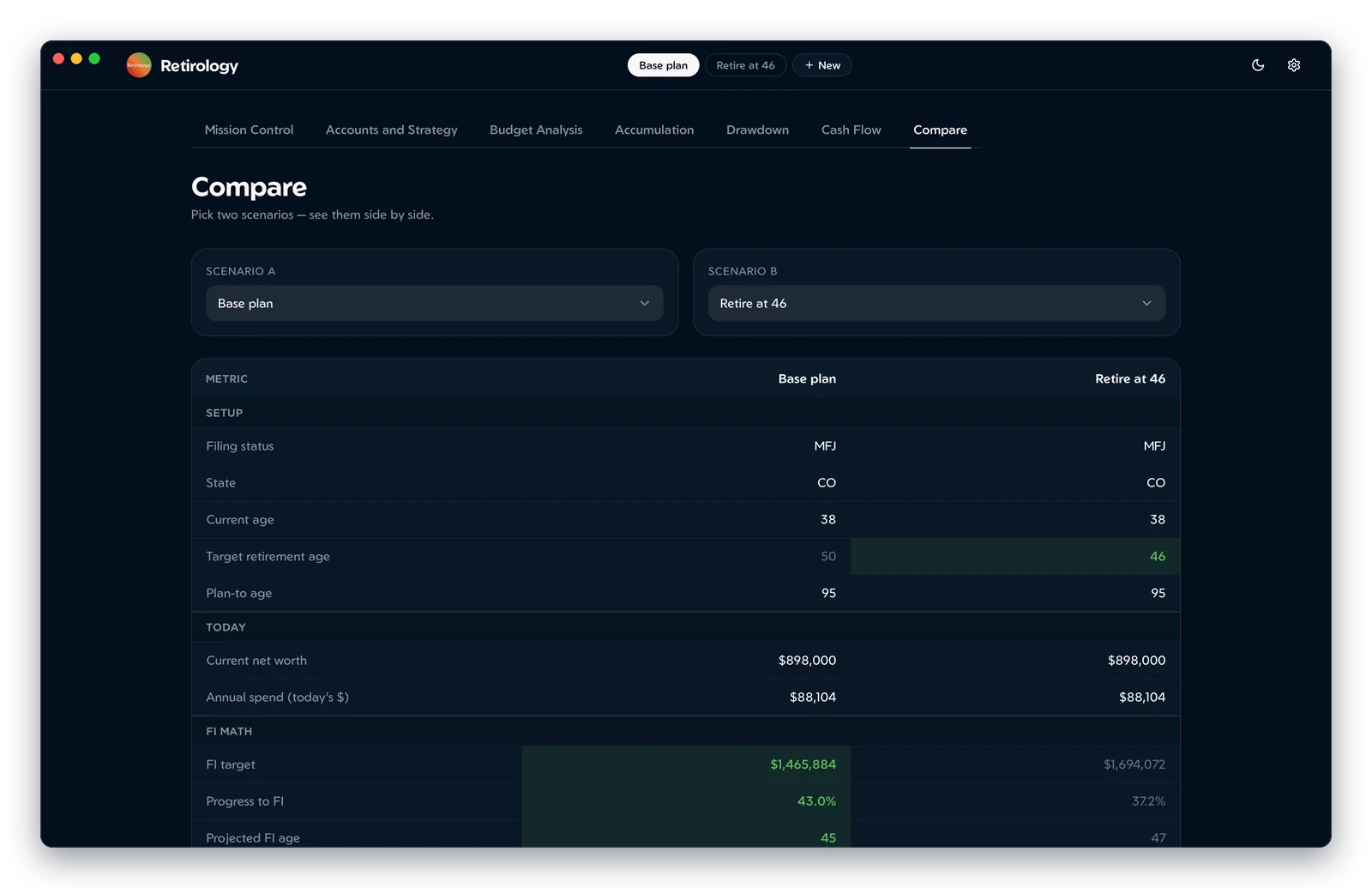
Save plans and put any two side by side — retire at 46 or 50, claim at 62 or 70, stay or move states — with the differences highlighted, from FI date to lifetime tax and after-tax money left.
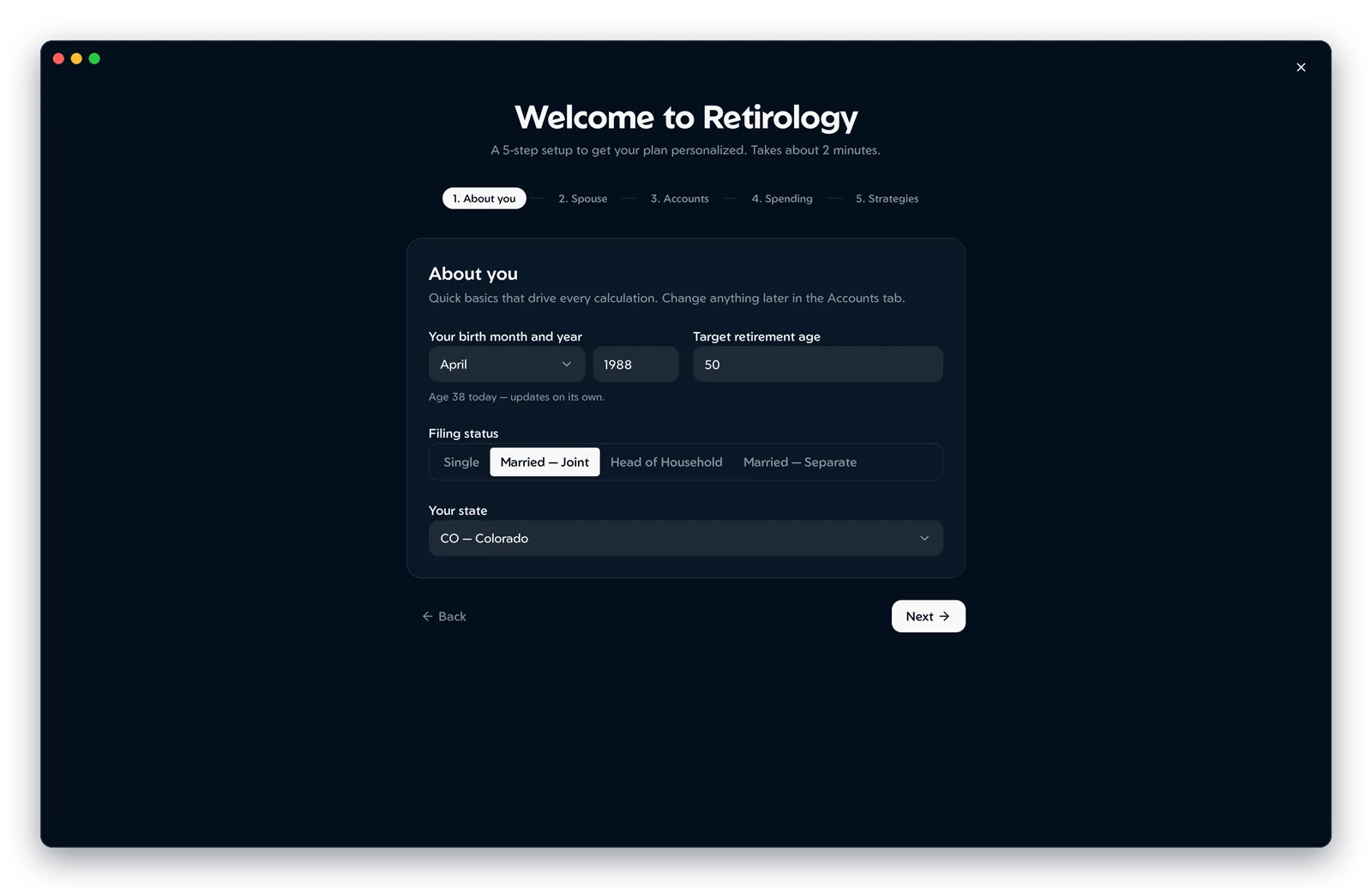
A short wizard — about you, your spouse, accounts, spending, strategies — gets a personalized plan in a couple of minutes. Defaults are sensible and everything is editable later, down to each account's dividend yield.
Also modeled
Spouse still working after you retire · dependents for ACA household size · lifestyle changes over time · one-time expenses · property sales with the home-sale exclusion · mortgages and ARMs that pay off · pensions and annuities with survivor benefits · HSAs · dividends and capital gains · cash interest · per-person Medicare and IRMAA · heirs' tax on what's left · PDF export of your plan.
Alternative to
If you've been comparing retirement planners like ProjectionLab, Boldin (formerly NewRetirement), MaxiFi Planner or Pralana, budgeting apps like Monarch or YNAB, or you've outgrown spreadsheets and free FIRE calculators — Retirology covers the retirement math for less than a single year of any of their subscriptions. See the comparisons.
Typical subscription planner
$100–$170 / year, every year
$1,000–$1,700 over ten years of planning
Retirology
One-time$19+ once
$65 suggested — less than half a year of a typical subscription
Subscription range based on the published annual prices of popular planners and budgeting apps in October 2026. Even at the suggested $65, Retirology costs less than one year of any of them — and you keep it.
Privacy isn't a tagline
Most retirement tools want you to upload your entire net worth to their servers. Retirology runs the math locally. We have nothing to leak because we have nothing to collect.
Verify it yourself. Run any network monitor (Little Snitch on Mac, your firewall, Wireshark) and confirm: exactly one HTTPS GET to retirology.app/version.json per launch. Nothing else.
A once-per-launch fetch of retirology.app/version.json to check for updates. It's a static file. No headers about you, no IDs, no telemetry.
Every account, every scenario, every dollar lives in one file on your disk. Back it up, encrypt it, delete it. Your call.
There's nothing to sign up for. The app launches and works. The only thing you give us at purchase is an email — for the receipt.
No Google Analytics, no Mixpanel, no Sentry, no chat widget. Not in the app. Not on this website.
Honest pricing
Retirology is a one-time purchase with a $19 floor — pick the tier that feels fair. Buy once and every future version is yours free. There's just one product; the tier you choose is what you pay.
Floor
$19 one-time
The minimum. Same app, same features. Pay what you can — no judgment.
Suggested
Most pick this$65 one-time
Less than half a year of a typical planner subscription — except you own it, updates and all.
Generous
$200 one-time
For folks who want to back the project meaningfully. You can also enter a custom amount in checkout.
Every update is free, forever — patches, new features, and the annual releases with refreshed tax tables. Buy once, and you never pay again. Re-download any version anytime from your account.
Learn
Free, plain-English guides — no sign-up.
How every state taxes retirement income
All 50 states and DC under 2026 law, with what a typical retired couple pays in each.
The Roth conversion ladder, explained
Reach 401(k) and IRA money before 59½ without the penalty, and what it costs in 2026.
The ACA subsidy cliff in 2026
Where the 400% line is, what counts toward it, and how early retirees stay under it.
Rule of 55 vs. 72(t)
Two ways to take retirement money early without the 10% penalty — and their traps.
What your Monte Carlo success rate means
A sensible target, why 100% is the wrong goal, and the assumptions that move it.
How to work out your FI number
Why 25× spending is only a start, and what taxes, healthcare and Social Security change.
Affiliate program
Because Retirology's price is set by the customer above a $19 floor, there's no per-sale ceiling on what you earn. Most affiliate programs cap your commission at a percentage of a fixed price. Ours scales with whatever the buyer actually pays.
If they pay $19
$3.80
your commission
If they pay $65
$13.00
your commission
If they pay $200
$40.00
your commission
Questions
Nothing in the software. The app and every feature are identical regardless of tier. The price you choose is what funds the next release. $19 is the floor; $65 is what we suggest if it's not a stretch; $200 is for folks who want to back the project.
No. You pay once and own it. Every update after that — bug-fix patches, new features, and the annual releases with refreshed tax tables — is free, forever. There's no renewal, no per-year charge, nothing to cancel.
Yes — all 50 states and DC under 2026 law, including the rules that matter to retirees: retirement-income exclusions by age, how Social Security is taxed, capital-gains breaks, and rate changes already passed for later years. Local income taxes like New York City's are included too. See how your state taxes retirees.
No, on purpose. You type in your balances — a few minutes, a few times a year — and no financial logins or account data ever leave your computer.
Stays on your machine in a single SQLite file. We don't see it, can't read it, and have no way to. See the privacy section or the full privacy statement for the per-OS file paths.
Never. Each year's release refreshes the tax tables and adds new features, and it's free for everyone who's bought Retirology — no upgrade fee, no discount code to hunt for. When a new version is out, the app points you to your account, where you re-download the latest build at no charge.
The app keeps working. There are no servers it depends on — the only network call is the once-per-launch update check, and if that fails the app just continues. Your data lives in a local SQLite file you own, so nothing remote is required for the app to function — and your copy keeps running indefinitely.
macOS: the app is signed and Apple-notarized — you'll see the standard one-time "downloaded from the Internet, are you sure?" prompt the first time you open it. Click Open and you're in. Windows: SmartScreen flags installers without an established reputation — click More info → Run anyway. (An EV signing cert is on the post-launch roadmap.) Linux: chmod +x the AppImage and run it.
A modest one-time price keeps the project sustainable without ads, accounts, subscriptions, or upsells — which is the whole point. The $19 floor is intentionally low; if it's genuinely out of reach, email contact@retirology.app and we'll work something out.
Download once, plan forever. macOS, Windows, Linux. No account needed.