
Guides
The ACA subsidy cliff in 2026, for early retirees
If you retire before 65, health insurance is often your biggest cost — and in 2026 the subsidy that pays for it has a hard cutoff again. One dollar of income over the line can cost thousands. Here's where the line is and how early retirees stay under it.
Updated October 2026
How the premium tax credit works
If you buy health insurance on the ACA marketplace, the premium tax credit caps what you pay for the benchmark silver plan at a percentage of your household income. For 2026 that percentage runs from 2.10% to 9.96%, rising with income; the IRS set 2027's top rate at 10.22% (Rev. Proc. 2026-26). The credit pays the rest of the premium.
Income is measured against the federal poverty level (FPL). Plans for 2026 use the 2025 poverty guidelines: $15,650 for one person and $21,150 for two in the 48 contiguous states and DC.
The cliff is back in 2026
From 2021 through 2025, temporary "enhanced" credits removed the upper income limit. They expired at the end of 2025. For 2026, the original rule applies again: above 400% of FPL, there is no credit at all.
| Household | 100% FPL | 250% FPL | 400% FPL (the cliff) |
|---|---|---|---|
| 1 person | $15,650 | $39,125 | $62,600 |
| 2 people | $21,150 | $52,875 | $84,600 |
| 3 people | $26,650 | $66,625 | $106,600 |
Illustration. Say the benchmark silver plan for a couple in their late 50s costs $24,000 a year. At $84,600 of income they pay 9.96% of it — $8,426 — and the credit covers the other $15,574. At $84,700 they pay the full $24,000. A hundred dollars of extra income costs over $15,000.
Congress may still change this: the House passed a three-year extension of the enhanced credits in January 2026, but as of this writing it hasn't passed the Senate. Check HealthCare.gov for the rules in force when you enroll.
What counts as income
The ACA uses modified adjusted gross income (MAGI): your AGI plus tax-exempt interest, untaxed foreign income and the non-taxable part of Social Security. In practice:
| Counts toward ACA MAGI | Doesn't count |
|---|---|
| Roth conversions | Spending cash savings |
| Traditional 401(k) and IRA withdrawals (including SEPP) | Withdrawing Roth IRA contributions or seasoned conversions |
| Capital gains, dividends and interest | The cost-basis part of investments you sell |
| Pensions, rental income, part-time wages | Qualified HSA withdrawals for medical bills |
| All Social Security, taxable or not | Loans and gifts |
That second column is the early retiree's toolkit: you can spend $90,000 a year while reporting $60,000 of MAGI if the difference comes from cash, Roth contributions or investment basis.
Managing MAGI in early retirement
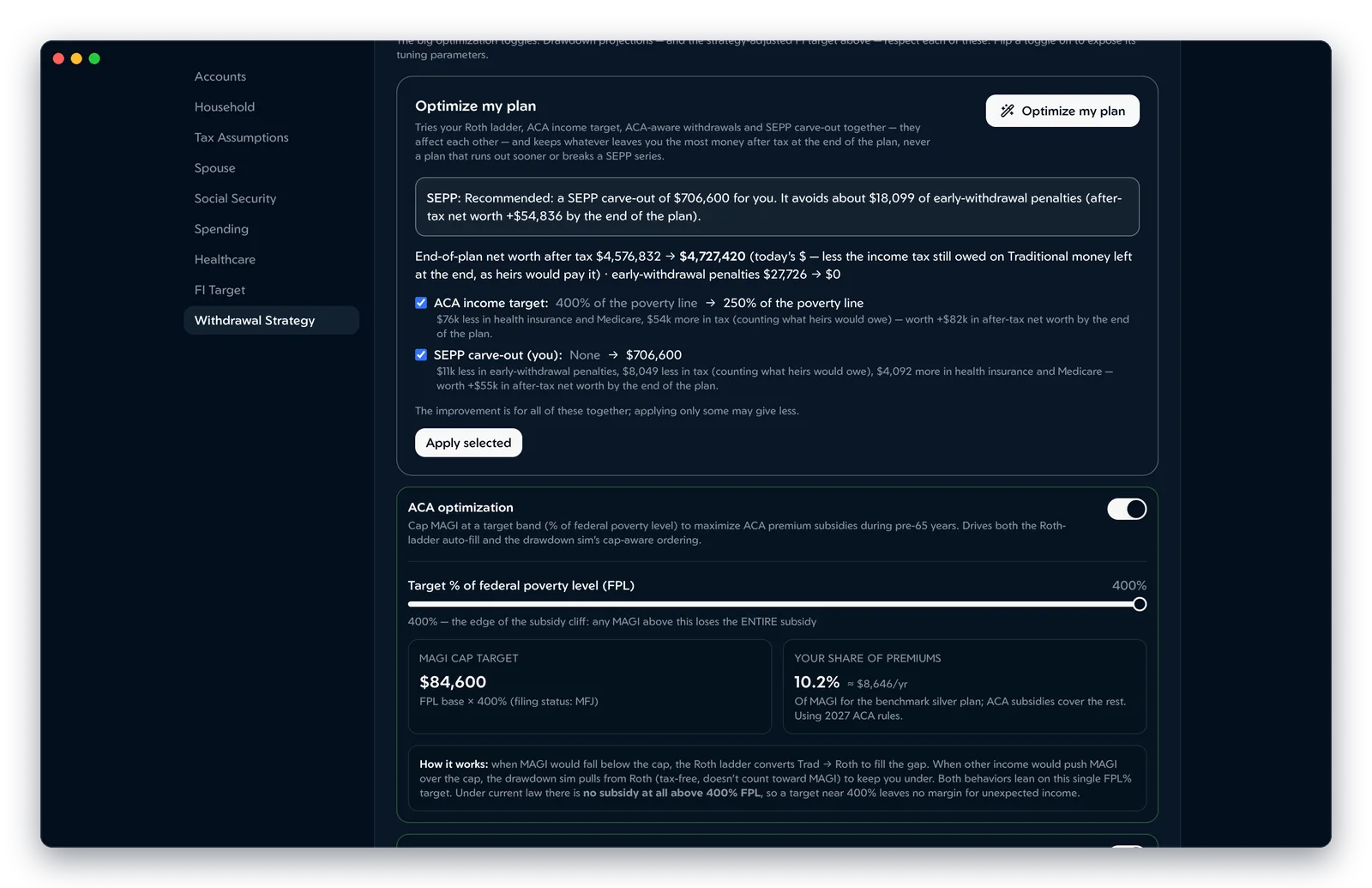
- Pick a target and fill to it. Decide on an income target safely under the cliff, then use Roth conversions to fill any room left after your other income. Unused room under the cap is wasted cheap tax space.
- Leave a margin. Dividends and fund distributions can surprise you in December. A target of 380%–390% of FPL leaves room; 400% exactly leaves none.
- Don't go too low. Below 100% of FPL you don't get the credit, and in states that expanded Medicaid, income under 138% of FPL means Medicaid instead of a marketplace plan.
- Watch both tax and premiums. A lower target can save more in premiums than it costs in tax — or the reverse. It depends on your premiums, your Traditional balance and your state.
After 65: IRMAA
Once you're on Medicare, the subsidy cliff is replaced by IRMAA — income-based surcharges on Medicare Part B and D premiums. They use your MAGI from two years earlier, so large conversions at 63 and 64 can raise your Medicare premiums at 65 and 66. A good plan looks at both lines together.
Common questions
What is the ACA subsidy cliff for 2026?
For 2026 coverage, households with income above 400% of the federal poverty level get no premium tax credit. Using the 2025 poverty guidelines that apply to 2026 plans, that's $62,600 for one person and $84,600 for two in the 48 contiguous states and DC (higher in Alaska and Hawaii).
Did the enhanced ACA subsidies get extended?
The enhanced credits, which removed the cliff, expired at the end of 2025. The House passed a three-year extension in January 2026, but as of this writing it hasn't become law. Check HealthCare.gov for the latest before you rely on either set of rules.
Does a Roth conversion count toward ACA income?
Yes. ACA MAGI is your adjusted gross income plus tax-exempt interest and untaxed Social Security, so Roth conversions, Traditional IRA withdrawals, capital gains, dividends and interest all count.
What doesn't count toward ACA income?
Spending cash savings, withdrawing your Roth IRA contributions, and the cost-basis part of investments you sell don't count. That's what lets early retirees keep MAGI low while spending normally.