
Guides
How to work out your FI number
Your financial independence number is how much you need invested before work becomes optional. The classic shortcut is 25 times your annual spending. It's a fine start — and often wrong by hundreds of thousands of dollars in either direction.
Updated October 2026
The shortcut: 25× spending
The "4% rule" comes from research in the 1990s, including William Bengen's 1994 study and the later Trinity study: a retiree who withdrew 4% of their starting portfolio in year one, then raised that amount with inflation, never ran out over any 30-year period in US history. Flip it around and you get the shortcut: FI number = annual spending × 25.
| Annual spending | At 4% (25×) | At 3.5% (≈28.6×) | At 3.25% (≈30.8×) |
|---|---|---|---|
| $40,000 | $1,000,000 | $1,142,857 | $1,230,769 |
| $60,000 | $1,500,000 | $1,714,286 | $1,846,154 |
| $80,000 | $2,000,000 | $2,285,714 | $2,461,538 |
| $100,000 | $2,500,000 | $2,857,143 | $3,076,923 |
Why early retirees often use a lower rate
The 4% rule was tested over 30 years. Retire at 45 and your money may need to last 50. Over longer periods the historically safe rate drops, which is why many early retirees plan around 3.25%–3.5% — unless other income, like Social Security, will cover part of their spending later.
What the shortcut leaves out
- Taxes. A dollar in a Traditional 401(k) isn't a dollar of spending; it still owes income tax. A Roth-heavy portfolio needs less than a Traditional-heavy one.
- Health insurance before 65. Premiums depend on your income under the ACA. A plan that keeps income low can need noticeably less. See the ACA subsidy cliff.
- Social Security and pensions. If $30,000 a year starts at 67, your portfolio only has to carry the full load until then. That can cut the target by hundreds of thousands.
- Spending that changes. A mortgage that's paid off at 58, kids leaving home, slower travel in your 80s — real spending isn't flat.
- Your state. The same withdrawals can cost $0 or several thousand a year depending on where you live.
Start with what you actually spend
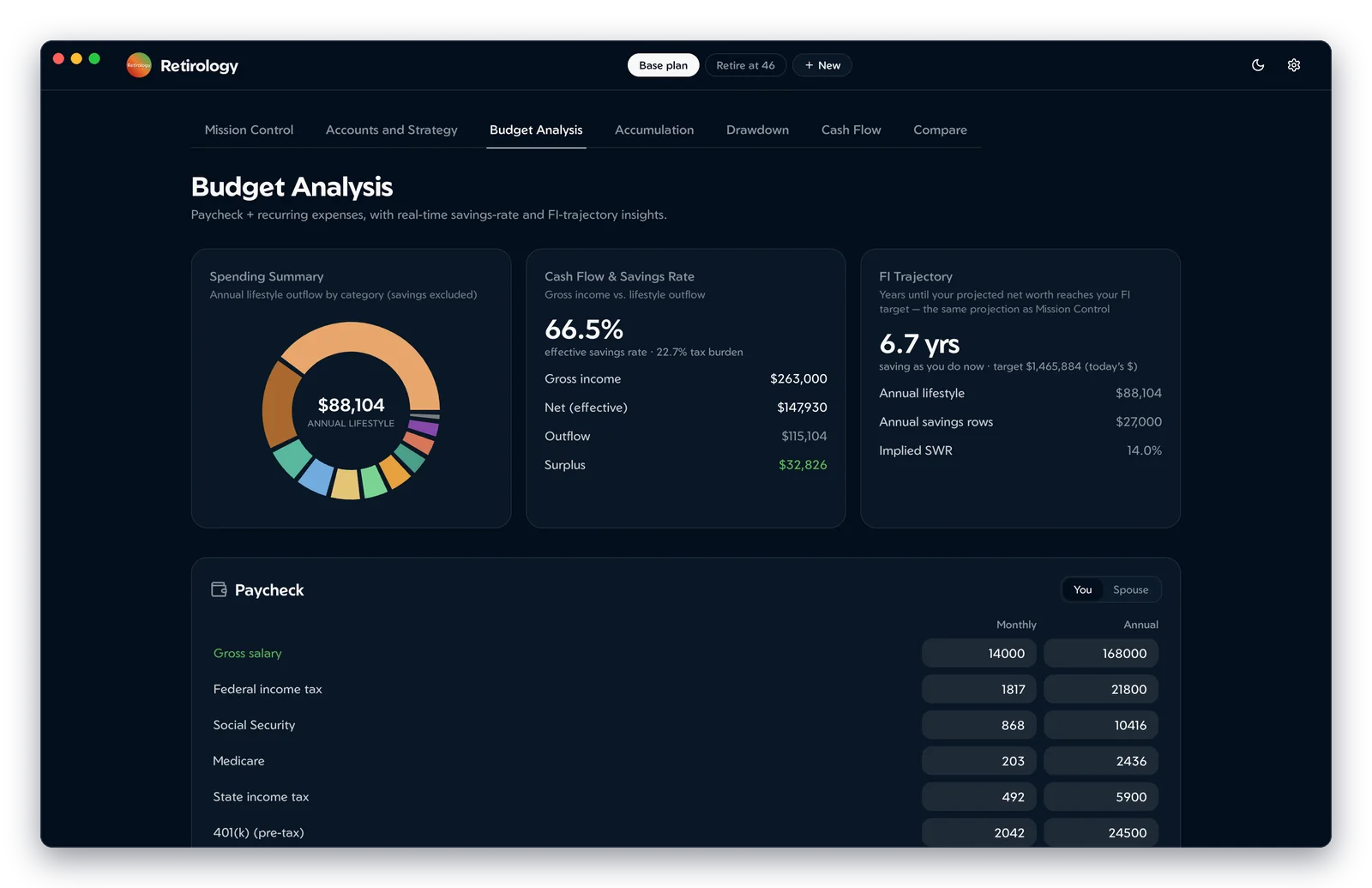
The biggest error in most FI numbers is the spending figure. Build it from your real budget, category by category, and decide what changes in retirement: no more commuting or retirement contributions, but your own health insurance, more travel, and eventually home repairs or a new car.
Count the right assets
Measure progress with investable assets — retirement accounts, brokerage, cash and HSA — not net worth. Home equity can't pay the grocery bill unless you sell or borrow against the house. And keep both the target and your balance in today's dollars, so the gap isn't flattered by inflation.
A better target: simulate the plan
Instead of multiplying, you can ask a more precise question: how much would I need at my retirement date for this exact plan — my spending, Social Security, taxes and healthcare — to last to the end, with a margin for bad returns? That's a plan-based target. It often lands well away from 25×, and it tells you which lever matters most: spending, retirement date, claim age or withdrawal strategy.
Common questions
What is the 4% rule?
A rule of thumb from 1990s research: withdrawing 4% of your starting portfolio, then adjusting for inflation each year, survived every 30-year US historical period studied. Multiplying spending by 25 is the same rule in reverse.
What withdrawal rate should an early retiree use?
Retirements of 40 to 50 years have less margin than the 30 years the 4% rule was built on, so many early retirees plan around 3.25% to 3.5% — about 29 to 31 times spending — unless other income like Social Security covers part of it.
Does home equity count toward my FI number?
Usually not. The FI number is about money that can pay for spending — retirement accounts, brokerage, cash and HSAs. Your home only counts if you plan to sell or borrow against it.
Should my FI number be in today's dollars?
Yes. State the target and your progress in today's dollars so they're comparable. A projection in future dollars will always look closer than it is.