
Guides
Rule of 55 vs. 72(t): getting at retirement money early
Retiring before 59½ usually means needing some Traditional 401(k) or IRA money before the penalty-free age. Two IRS exceptions make that possible without the 10% penalty — with very different rules.
Updated October 2026
At a glance
| Rule of 55 | 72(t) SEPP | |
|---|---|---|
| Earliest age | Leave your job in or after the year you turn 55 (50 for qualified public-safety workers) | Any age |
| Which accounts | Only the 401(k)/403(b) of the employer you left | IRAs, or a plan of an employer you've left |
| How much | Whatever you need, whenever the plan allows | A fixed amount set by an IRS formula |
| How long | No commitment | The longer of 5 years or until 59½ — no changes |
| Main risk | Rolling the plan to an IRA kills it | Any change triggers the penalty on every payment so far |
Both remove only the 10% early-withdrawal penalty. The money is still taxed as ordinary income. The exceptions are listed in the IRS's exceptions to tax on early distributions.
The Rule of 55
If you separate from an employer in or after the calendar year you turn 55, withdrawals from that employer's 401(k) or 403(b) aren't penalized. You don't have to retire for good; you just have to leave that job at 55 or later.
- It's plan-specific. Money in an old employer's plan you left at 50 doesn't qualify. Many people roll old 401(k)s into their current plan before leaving, so more money qualifies.
- Keep the money in the plan. Roll it to an IRA and the exception is gone for that money.
- Check the plan's rules. Some plans only allow a single lump sum, and plans withhold 20% federal tax from most distributions (you settle up when you file).
- Governmental 457(b) plans have no 10% penalty at all after you leave the job, at any age.
72(t) substantially equal periodic payments
A SEPP lets you take a series of equal payments from an IRA at any age. The annual amount comes from one of three IRS methods (Notice 2022-6):
- Required minimum distribution: balance ÷ life expectancy, recalculated every year. Smallest payments; they vary.
- Fixed amortization: the balance amortized over your life expectancy at an interest rate up to the greater of 5% or 120% of the federal mid-term rate. Fixed payments; usually the largest.
- Fixed annuitization: similar to amortization using an annuity factor.
Example. A $500,000 IRA at age 50, fixed amortization at 5% over the single life expectancy of 36.2 years, gives about $30,150 a year. Need less? Split off a smaller IRA and run the SEPP on just that — the rest stays flexible.
Once started, payments must continue unchanged until the later of five years or age 59½. Start at 50 and you're locked in until 59½; start at 57 and you're locked in until 62. Take an extra dollar, skip a payment, or add money to the account, and the 10% penalty applies retroactively to every payment, plus interest.
Which should you use?
- Leaving work at 55 or later with most savings in that employer's plan: the Rule of 55 is simpler and more flexible.
- Retiring in your 40s or early 50s: a SEPP, a Roth conversion ladder, or both. A ladder needs five years of other money first; a SEPP doesn't, but it locks you in.
- Plenty of taxable savings: you may not need either for years. Selling investments only taxes the gain.
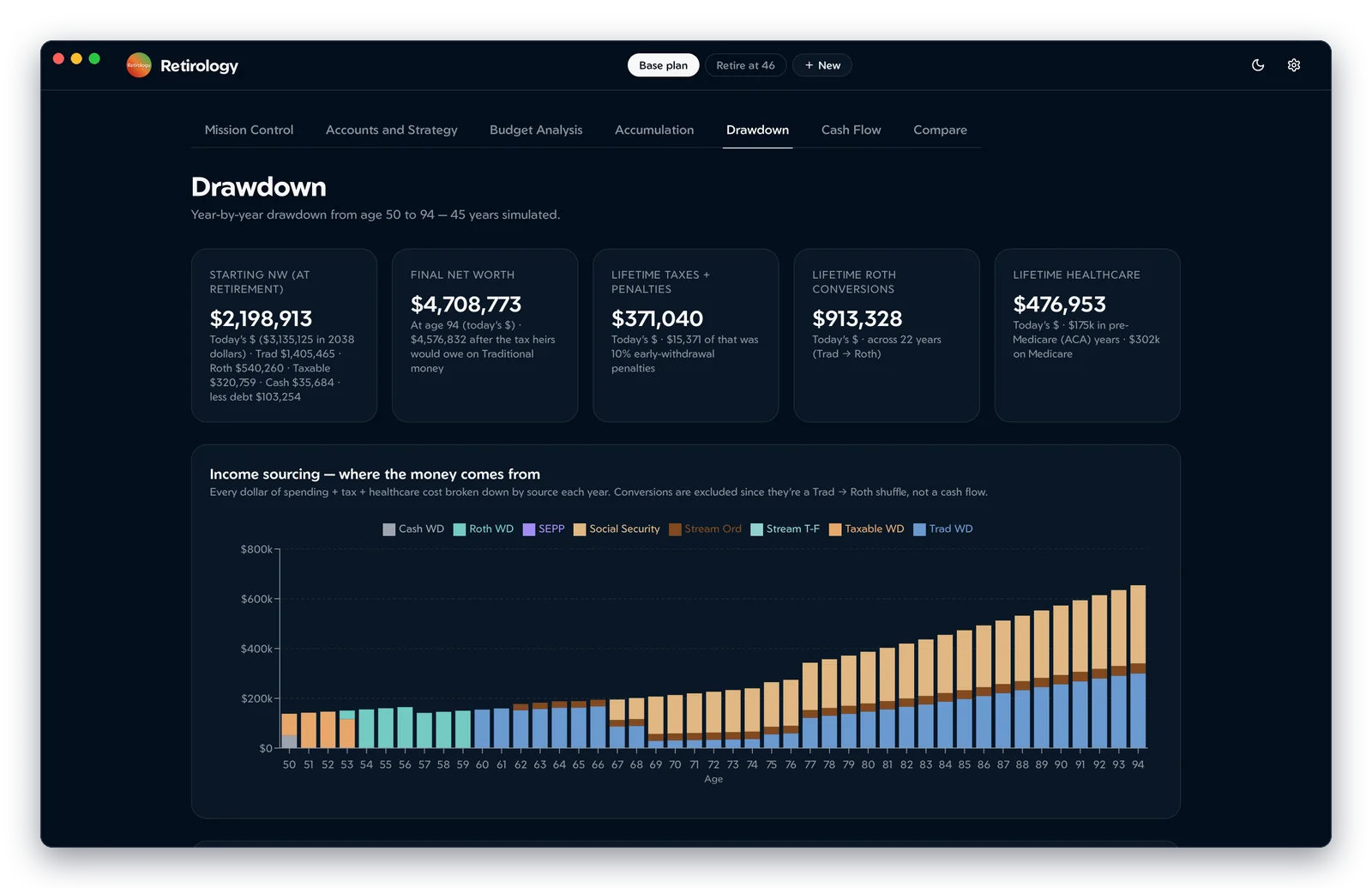
SEPP payments also count toward ACA income, so a large one can crowd out cheaper Roth conversions or push you toward the subsidy cliff. Sizing it as a carve-out for just the gap usually works best.
Common questions
Does the Rule of 55 apply to IRAs?
No. It only applies to the 401(k) or 403(b) of the employer you leave in or after the year you turn 55. Roll that money into an IRA and you lose the exception for it.
What happens if I change a 72(t) payment?
If you modify the payments before the later of five years or age 59½ — by taking more, less, or adding money to the account — the 10% penalty applies retroactively to every payment you've taken, plus interest. A one-time switch to the RMD method is allowed.
Can I use both the Rule of 55 and a SEPP?
Yes. They apply to different accounts: the Rule of 55 to the employer plan you left, a SEPP to an IRA (or a plan you've separated from). Some people use the Rule of 55 first and a ladder or SEPP for the rest.
Are Rule of 55 and SEPP withdrawals taxed?
Yes, as ordinary income. The exceptions only remove the 10% penalty. The withdrawals also count toward ACA income.