
YNAB alternative for retirement planning
Retirology vs. YNAB
YNAB — You Need A Budget — is a zero-based budgeting method and app that's helped a lot of people get control of their spending. It's not a retirement planner, and doesn't try to be. Here's where Retirology picks up.
Updated October 2026
The short version
| Retirology | YNAB | |
|---|---|---|
| What it is | Retirement and FIRE planner | Zero-based budgeting app |
| Price | $19+ once; every update free | $109/year or $14.99/month; 34-day trial |
| 10 years of use | $19–$65 total | $1,090 |
| Budgeting | Budget analyzer by category, savings rate | Full zero-based budgeting with synced transactions |
| Retirement projections | Accumulation, drawdown, Monte Carlo, stress tests | No |
| Retirement taxes | Federal + state, Roth conversions, ACA, IRMAA, SEPP | No |
| Your data | On your computer only | In your online account |
YNAB details are from its public pricing page as of October 2026.
From budget to FI date
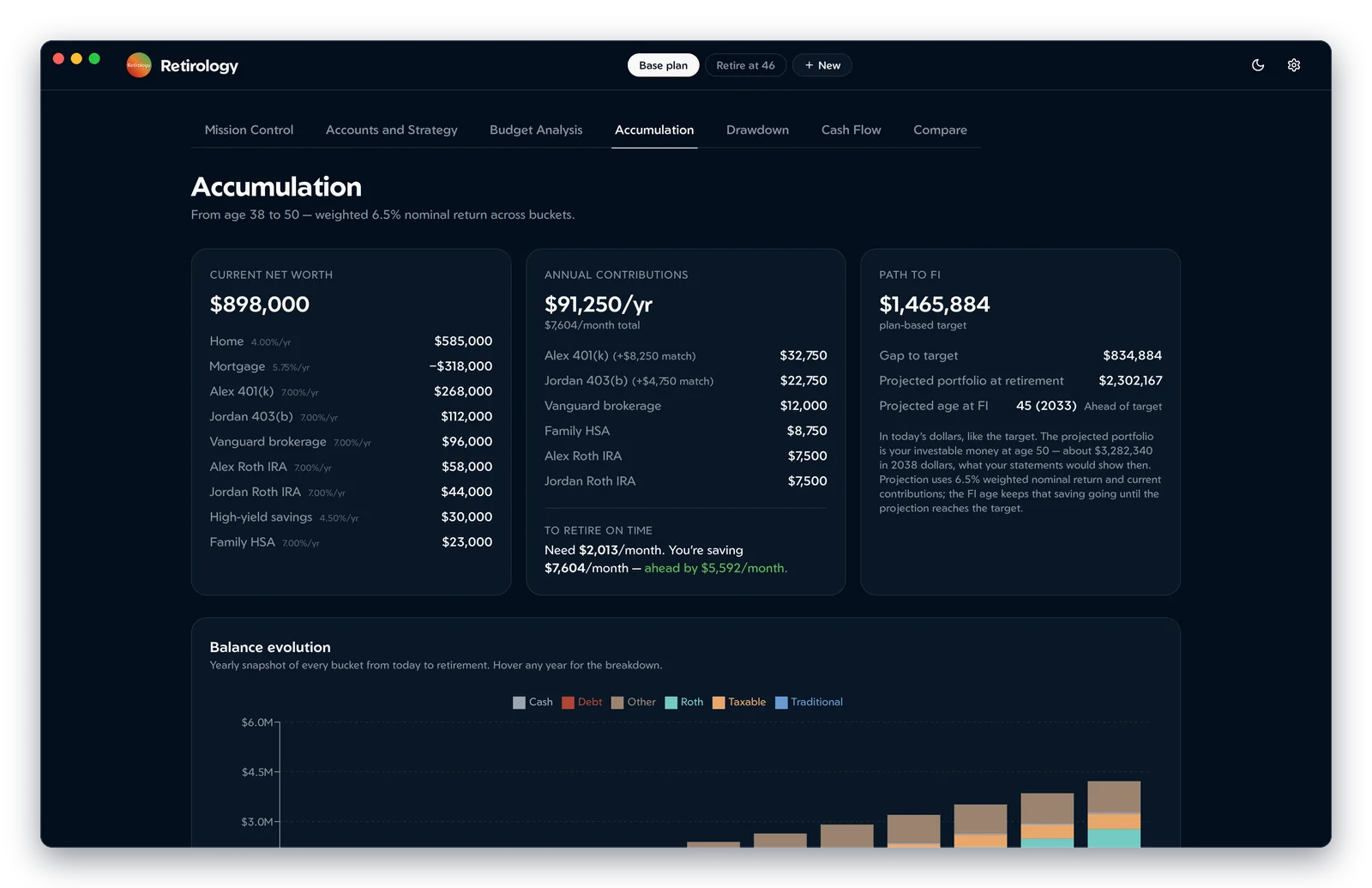
A good budget is the best input a retirement plan can have. Retirology takes your categories, lets you schedule changes (a paid-off mortgage, kids leaving home), and turns them into a plan-based FI target, the date you'll reach it, and a year-by-year drawdown with taxes and healthcare.
When YNAB is the better choice
- You need to get spending under control first — that's YNAB's whole purpose, and it's good at it.
- You want every dollar assigned a job, month by month.
Common questions
How much does YNAB cost?
YNAB's pricing page lists $109 a year or $14.99 a month, with a 34-day free trial.
Does YNAB do retirement planning?
YNAB's features are budgeting, goals, debt payoff and account syncing. It doesn't project retirement balances or model withdrawals and taxes in retirement.
How do I use my YNAB budget in Retirology?
Enter your monthly category amounts in Retirology's Budget Analysis. It uses them as your retirement spending — with any changes you schedule for when you stop working — to calculate your FI target and date.